Understanding Carpal Tunnel Syndrome (CTS)
What happens in the body
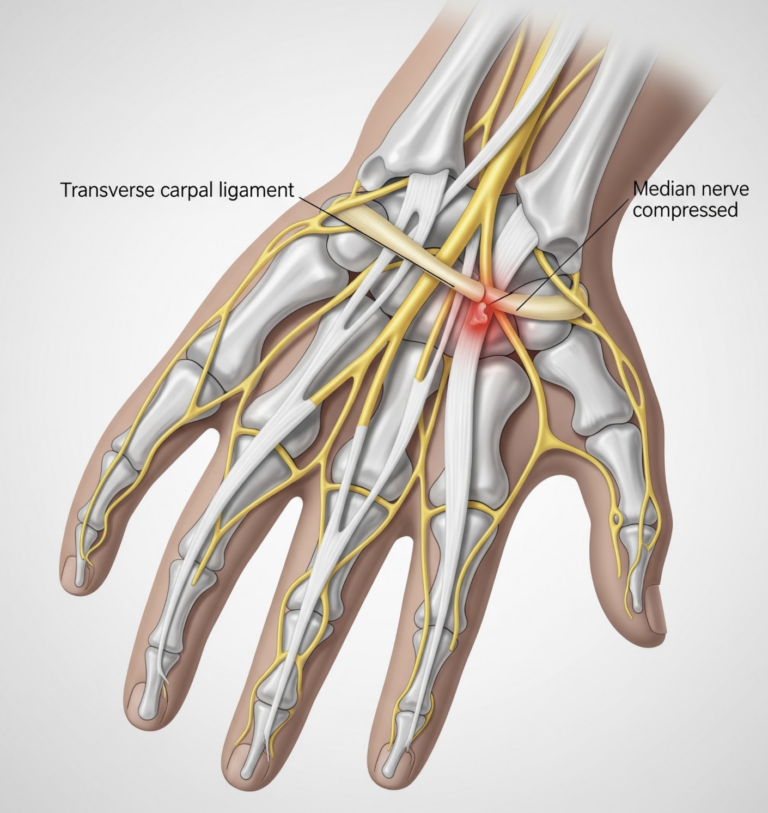
Carpal Tunnel Syndrome (CTS) occurs when the Median Nerve (which runs from the forearm into the palm) becomes compressed as it travels through the narrow “carpal tunnel” in the wrist. As a result, individuals may experience numbness, tingling, or weakness in the hand and wrist. Mayo Clinic+2MSD Manuals+2
The carpal tunnel is a rigid space formed by wrist bones and the flexor retinaculum (a ligament-roof) and contains the median nerve plus nine flexor tendons. Elevation of pressure or swelling in this tunnel can impact the nerve. SpringerLink+1
Mechanisms include increased tunnel pressure, tendon swelling, ischemia of the nerve, mechanical trauma, and impaired nerve gliding — all contributing to tingling, numbness, pain, or weakness in the thumb/index/middle-fingers area. Neuroquantology
Common risk-factors: repetitive hand/wrist use, wrist anatomy variations, female gender, diabetes, rheumatoid arthritis, obesity, pregnancy. Cleveland Clinic+1
Before beginning your practice:
- Move gently.
- Avoid movements that increase pain or numbness.
- Stop if symptoms worsen.
- Consult a healthcare professional if symptoms are severe.
Duration: 13-15 minutes
Goal: Gentle stretches support nerve-glide awareness, non-weight-bearing wrist positions help decompress the median nerve and encourage healthy tissue movement.
(Note: These suggestions are educational in nature. Do not interpret them as medical advice. Always proceed gently, and stop any pose that causes pain, tingling, or worsening symptoms).
1. Wrist Circles – 1 minute
- To begin, sit comfortably with your spine tall and your shoulders relaxed. Extend arms in front with palms down.
- Next, gently rotate both wrists in slow circles while maintaining smooth, relaxed breathing, clockwise for 30 seconds, then counter-clockwise for 30 seconds.
- Focus on gentle awareness of wrist movement.
- Evidence: Encourages blood flow and joint mobility around the carpal tunnel region, (Mayo Clinic, 2024).
2. Prayer/Reverse Prayer Wrist Stretch – 2 minutes
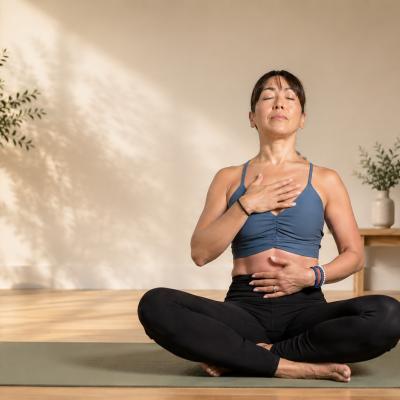
- Bring palms together in front of the chest where the sternum lies.
- Then slowly lower hands toward waist until you feel a gentle stretch in the wrists and forearms.
- Hold the stretch only to a comfortable point without forcing the movement. Hold ~30 seconds.
- Flip hands so backs touch (“reverse prayer”) and hold ~30 seconds.
- Repeat once.
- Evidence: Shown to gently elongate wrist flexor and extensor tendons, promoting space within the carpal tunnel, (Kerwin, Williams, & Seiler, 1996; Yoga Journal, 2025).
3. Finger and Thumb Spreads / Wrist Extension Support – 1 minute
- Extend one arm, palm facing down, gently use other hand to lift the fingers and thumb upward (wrist extension) hold ~15 seconds, slightly bend fingers (wrist flexion) ~15 seconds. Switch sides.
- Repeat.
- Evidence: Supports tendon mobility and median nerve gliding, (Aboonq, 2015).
4. Table Top with ‘Fists to Flat’ Variation – 2 minutes
- Come to hands and knees (wrist directly under shoulder). Make gentle fists with both hands, then open fingers wide and flatten palms. Repeat this “fist→flat” motion ~6–8 times slowly.
- Evidence: Mobilizes hand/wrist/forearm in a controlled, supported position — avoids deep extension that may aggravate CTS, (Yoga International, 2024).
5. Eagle Arms / Forearm Focus (bird-dog variation) – 2 minutes
- From hands/knees, cross right forearm under left and wrap if comfortable (eagle arms) while keeping wrists supported on mat. Hold ~1 minute.
- Switch sides for 1 minute.
- Evidence: Focuses on upper limb tension release and may decrease shoulder/forearm strain that influences wrist load, (Garfinkel et al., 1998).
6. Supported Dolphin/Forearm Plank – Hold ~30 seconds
- With forearms on mat, hold forearm plank for ~30 seconds (or shorter if wrists sensitive). Focus on neutral wrist, strong forearm engagement, and core awareness.
Evidence: Strengthens supportive musculature of shoulders and arms to decrease distal wrist stress, (Garfinkel et al., 1998; Aboonq, 2015).
7. Final Rest with Gentle Wrist Stretch (Savasana) – 1 minute
Lie on back or sit comfortably. Extend arms overhead, palms facing each other. Let wrists relax, maybe gently shake out the hands, rest arms along side body, close eyes for 30 seconds.
- Evidence: Mindful relaxation helps calm the sympathetic nervous system and reduces tension, (Yoga International, 2024).
Ongoing Support Strategies
Ergonomic aids: keyboard/mouse wrist support, keep wrists neutral during typing/phone use.
Frequent micro-breaks during repetitive hand/wrist tasks (every 20–30 minutes).
Maintain overall upper-body/postural health (core, shoulders, neck) to minimize wrist load.
Incorporate daily gentle wrist/forearm mobility (as above) and 3–4 times/week mindful hand/wrist yoga.
- If symptoms persist or worsen (especially night tingling/weakness), consult qualified health provider for assessment.
Continue Your Wellness Journey
Ready to take the next step toward better breathing and overall wellness?
At ANIKO Lifestyle & Wellness, we offer personalized wellness consultations and evidence-informed yoga guidance designed to complement your healthcare plan.
You may also enjoy:
- Breathwork Basics for Inner Peace
- Gentle Yoga for Chronic Back Pain
Interested in working together?
Schedule a consultation to explore how mindful movement, breathing techniques, and lifestyle practices can support your wellness goals.
Aboonq, M. S. (2015). The pathophysiology of carpal tunnel syndrome. Neurosciences Journal, 20(1), 4–9. Link
Garfinkel, M. S., Singhal, A., Katz, W. A., Allan, D. A., Reshetar, R., & Schumacher, H. R. (1998). Yoga-based intervention for carpal tunnel syndrome: A randomized trial. JAMA, 280(11), 1601-1603. Link
Kerwin, G., Williams, C. S., & Seiler, J. G. III. (1996). The pathophysiology of carpal tunnel syndrome. In Hand and Upper Extremity Rehabilitation: Theoretical and Evidence-Based Practice (pp. 21-35). Springer. Link
Mayo Clinic. (2024). Carpal tunnel syndrome: Symptoms & causes. Link
Yoga International. (2024). A yoga practice for carpal tunnel syndrome.Link
Yoga Journal. (2025, January 20). The best yoga poses for carpal tunnel syndrome.Link